
Building automation networks are changing. For decades, our industry has relied on technologies such as RS-485, BACnet MS/TP, and LonWorks Free Topology to connect controllers, sensors, actuators, and other field devices.
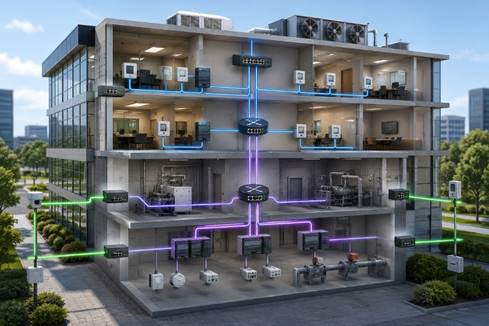
These technologies have served buildings well, but today’s systems require more: greater bandwidth, better cybersecurity, easier integration, and access to more operational data. Increasingly, that means moving more capable Ethernet and IP communication deeper into the building automation network.
BACnet/IP is an important part of that transition, but as BACnet moves onto IP networks, we encounter an important networking challenge: BACnet uses broadcasts while IP routers normally prevent local broadcasts from crossing between IP subnets.
That is where the integration of a BACnet Broadcast Management Device (BBMD) becomes important.
Likewise, as 10BASE-T1L Single Pair Ethernet extends Ethernet farther toward field controllers, understanding BBMDs becomes even more relevant.
What is BACnet/IP?
BACnet is a communications protocol developed specifically for building automation and control systems. It allows equipment such as HVAC controllers, lighting systems, sensors, access control systems, and building management systems to exchange information using a standardized framework.
BACnet/IP allows BACnet messages to travel across IP networks using UDP/IP (User Datagram Protocol / Internet Protocol).
This allows building automation systems to use anEthernet infrastructure, including switches, routers, VLANs, fiber, and other IP networking technologies.
The challenge begins when a BACnet/IP network is divided into multiple IP subnets.
Why IP Subnets Create a BACnet Challenge
Imagine a building with BACnet/IP controllers on two floors:
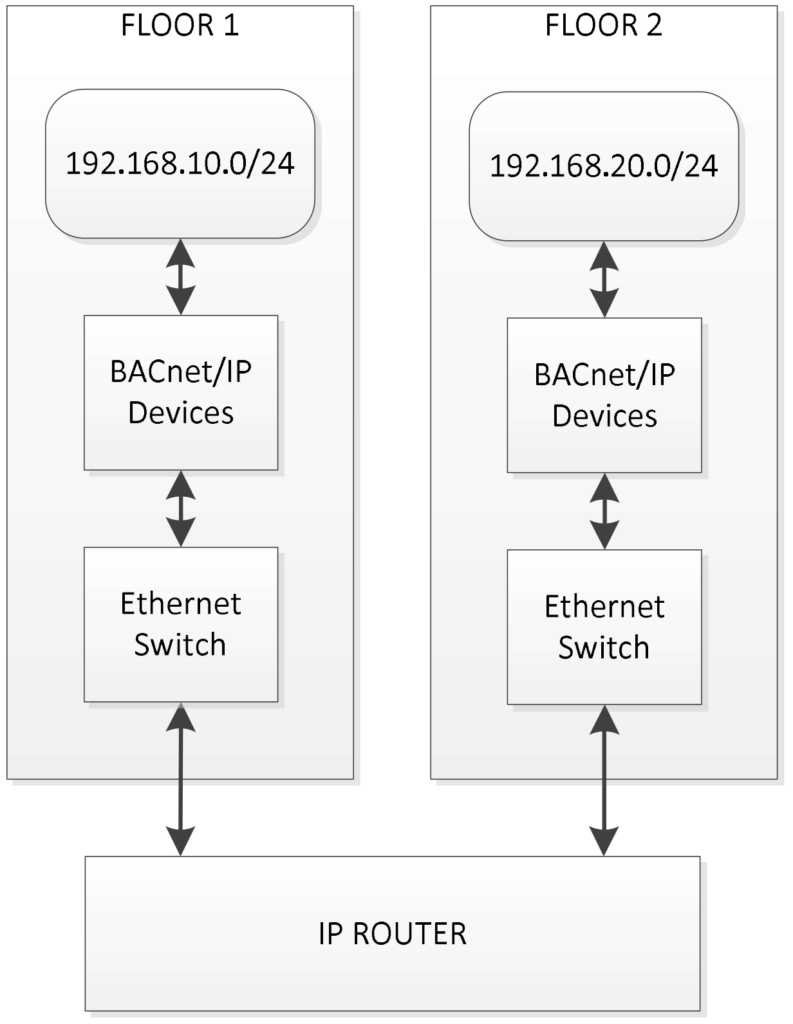
Dividing a network into subnets is normal IP network design. It can improve scalability, traffic management, and security.
However, BACnet relies on broadcast communication for important functions such as device discovery.
For example, a BACnet workstation can transmit a Who-Is message, essentially asking: “What BACnet devices are out there?” BACnet devices receiving the request can respond with an I-Am message.
On a single IP subnet, this works naturally.
Place an IP router between the devices, however, and something changes: normal local IP broadcasts generally do not cross that router.
A controller on Floor 1 may therefore be unable to discover controllers on Floor 2 using a local BACnet/IP broadcast, even though all of the equipment and the IP network are operating correctly.
This is Why We Need a BBMD
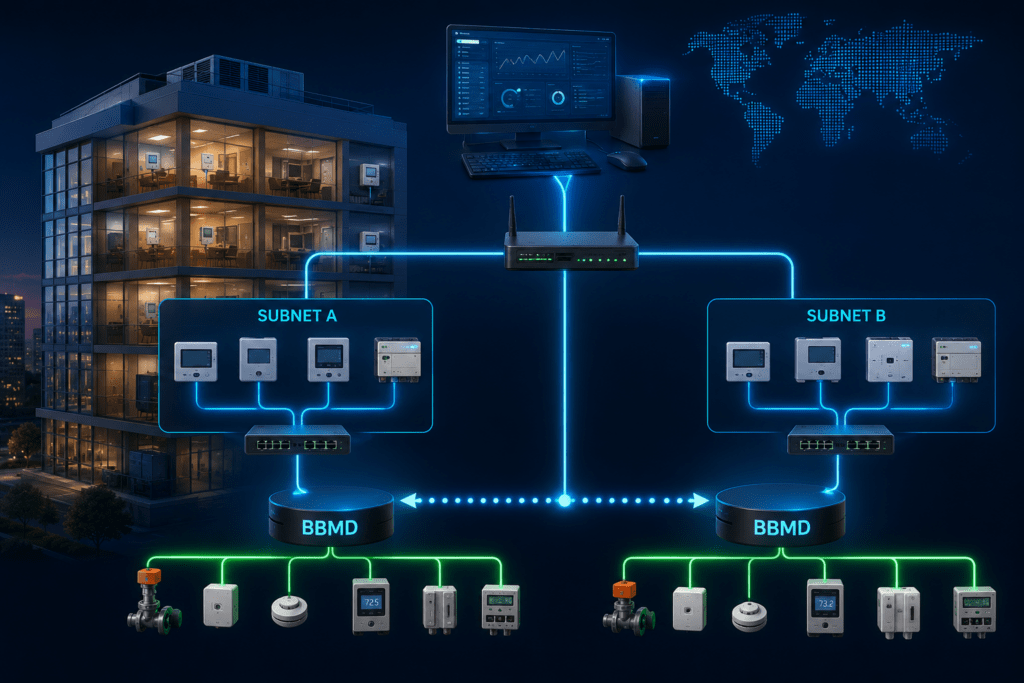
Its fundamental job is simple:
A BBMD enables BACnet broadcast information to be distributed between BACnet/IP devices located on different IP subnets.
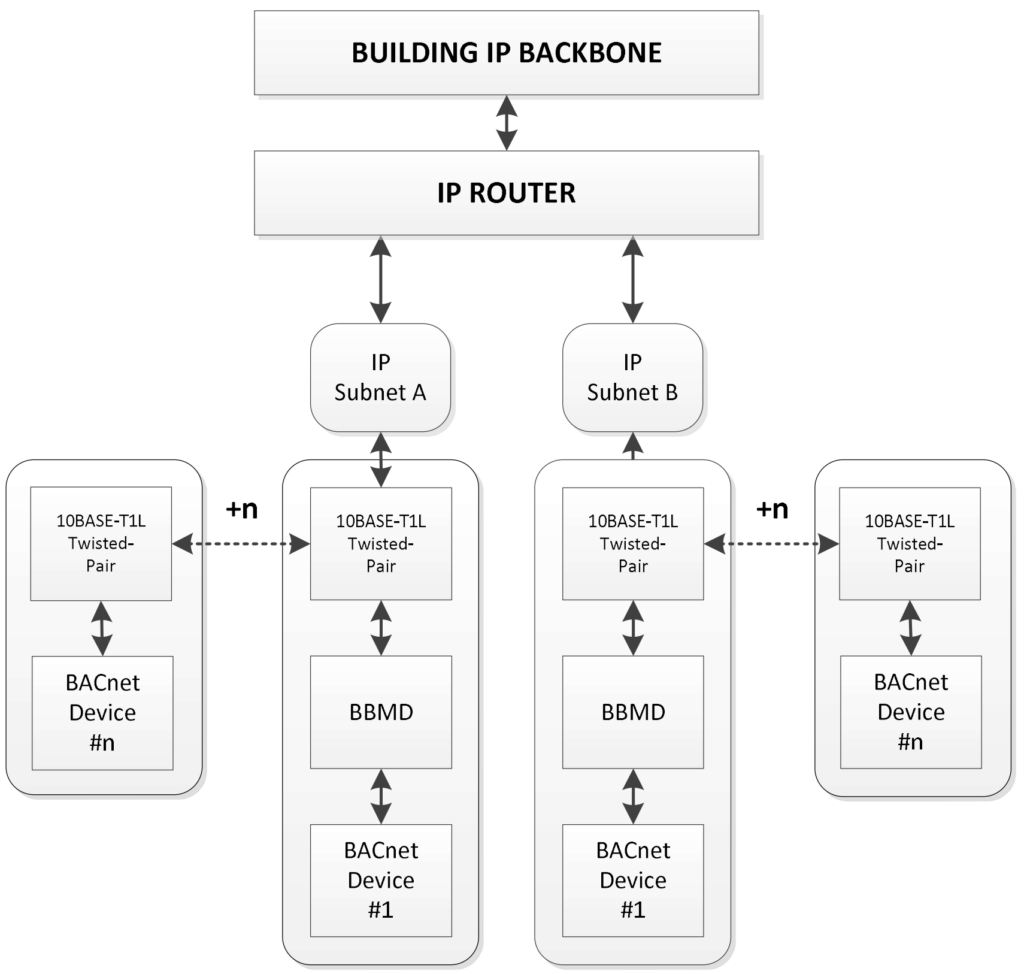
Consider our building again:
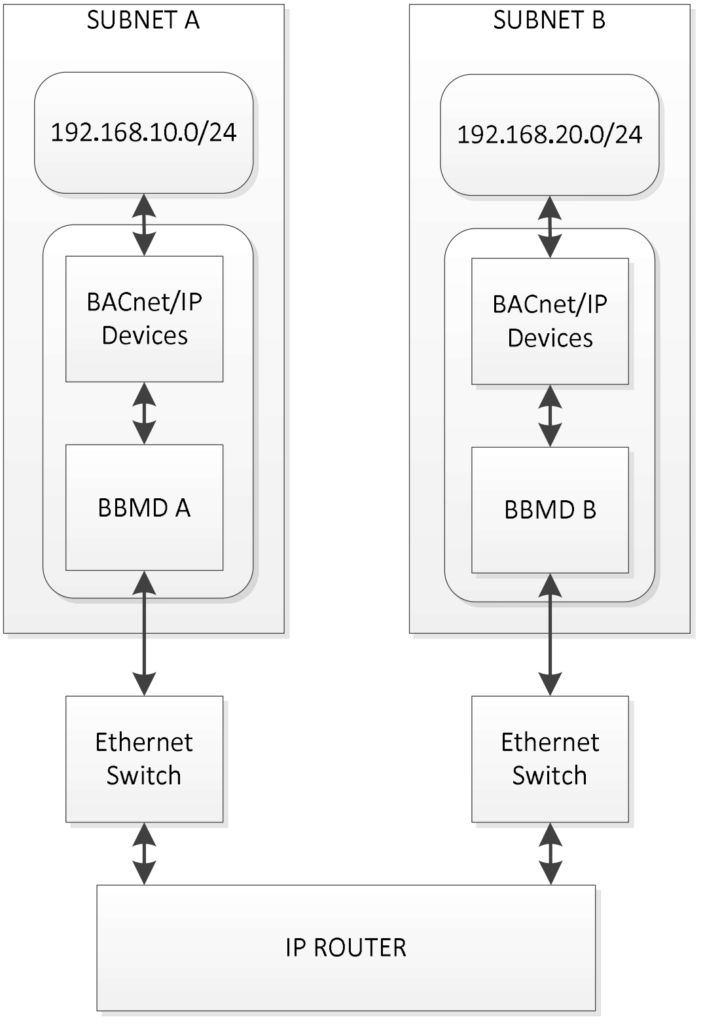
When an appropriate BACnet broadcast originates on Subnet A, the BBMD device on that subnet can distribute that information to the BBMD device on Subnet B. The receiving BBMD then makes the broadcast available on its local BACnet/IP subnet. It is important to note that only one device enabled with BBMD capability is required per subnet. The BBMD device acts as a broadcast representative for that subnet.
This allows BACnet discovery and other broadcast-dependent functions to operate across a larger routed IP infrastructure.
Later in this series, we will look deeper into how BBMDs accomplish this using the Broadcast Distribution Table (BDT) and how remote devices can participate through Foreign Device Registration (FDR) and the Foreign Device Table (FDT).
Where Does 10BASE-T1L Fit?
BBMDs solve a BACnet/IP networking problem.
10BASE-T1L solves a different problem: how to physically extend Ethernet much farther across the building.
Traditional Ethernet commonly uses multi-pair structured cabling. Building automation field networks, however, frequently use long runs of a single twisted pair, which is the basis of 10BASE-T1L.
10BASE-T1L provides 10 Mbps Ethernet communication over a single balanced twisted pair and is designed for links reaching up to approximately 1,000 meters under specified conditions.
That makes it particularly interesting for building automation.
The protocol stack can now look like this:
BACnet → BACnet/IP → UDP → IP → Ethernet → 10BASE-T1L → Single Twisted Pair
The important point to highlight here is that BACnet/IP communication does not have to change simply because the Ethernet physical layer changes.
BBMD and 10BASE-T1L Work Together
It is important not to confuse the two technologies.
| Technology | Primary Function |
| BACnet/IP | Carries BACnet communication over UDP/IP |
| BBMD | Manages BACnet broadcasts across IP subnets |
| IP Router | Routes IP packets between IP networks |
| 10BASE-T1L | Carries Ethernet communication over a single twisted pair |
Therefore, 10BASE-T1L does not replace a BBMD.
Instead, they can become complementary parts of a modern building automation architecture.
Why This Matters for Existing Buildings
This becomes particularly interesting when we consider retrofit applications.
Millions of buildings already contain extensive twisted-pair communication wiring installed for RS-485, BACnet MS/TP, LonWorks, and other control networks.
Replacing that wiring can be expensive and disruptive.
10BASE-T1L creates the possibility that some existing twisted-pair infrastructure may be reusable for Ethernet, provided the installed cable and network architecture are properly tested and verified to meet the electrical and topology requirements of the new system.
That qualification is important. We should never assume that an existing RS-485 or LonWorks cable automatically supports 10BASE-T1L.
But where the existing infrastructure is suitable, the opportunity is significant.
Instead of asking: “How do we replace the old network?”, perhaps the better question is: “How much of the building’s existing infrastructure can we preserve while creating a path toward Ethernet?”
A Practical Path Forward
Modernization does not require building owners to discard everything that already works.
A more practical strategy is to create an evolutionary path:
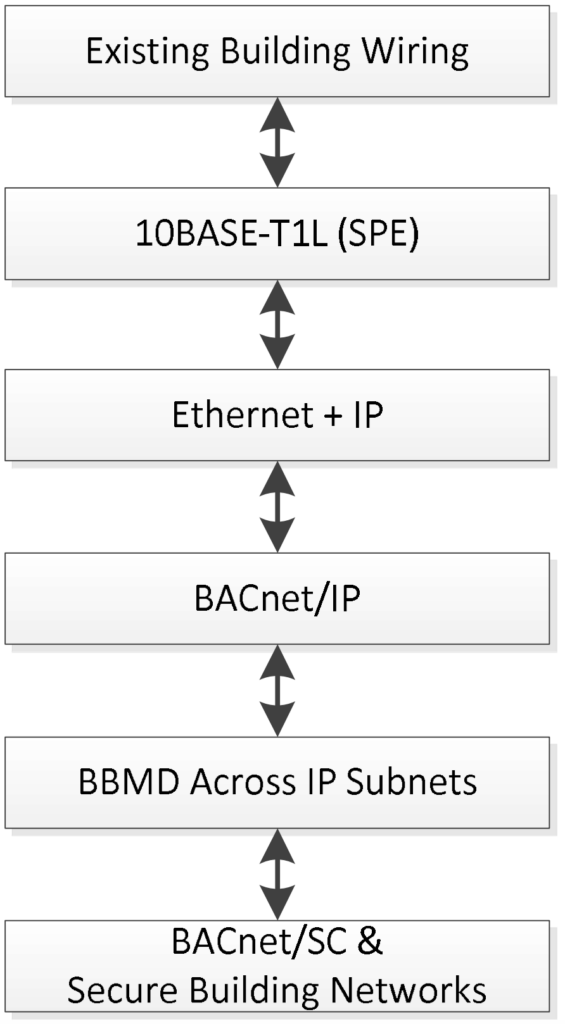
This is where the building automation industry has an important opportunity.
The objective should not simply be replacing yesterday’s technology. It should be preserving the investments that still have value while creating a practical path toward the building networks of tomorrow.
BBMD is one important part of making that transition possible.
Next: What is a BBMD?
In the next article, “What Is a BBMD? Managing BACnet Broadcasts Across Modern Ethernet Networks,” we will look inside the BBMD itself and follow a BACnet broadcast as it travels from one IP subnet to another.
That will give us the foundation to explore the BDT, FDT, BACnet routing, 10BASE-T1L, and eventually BACnet/SC as we continue building toward a modern building automation network.