

By David Kniepkamp, President, Smart Controls LLC
For more than thirty years, I have been involved in the design, installation, troubleshooting, and support of building automation control networks. During that time, I have worked with virtually every major communication technology used in commercial buildings, from proprietary field buses to LonWorks®, Modbus®, BACnet MS/TP, and BACnet/IP.
Each technology solved a problem of its time. Each helped move our industry forward.
Today, however, building automation systems are being asked to do much more than simply control HVAC equipment. Building owners want real-time data, remote access, energy analytics, indoor air quality monitoring, cloud connectivity, cybersecurity, and the ability to integrate systems across entire campuses.
These new requirements are placing greater demands on our control networks than ever before.
As we have been developing the next generation of Smart Controls products, including our 10BASE-T1L networking solutions, one question continues to come up:
What is the difference between BACnet MS/TP, BACnet/IP, and BACnet/IP over 10BASE-T1L, and which one is the best choice for future projects?
The answer can often depend on the application, but understanding the strengths and limitations of each communication method can help building owners, engineers, contractors, and system integrators make better long-term decisions.
BACnet MS/TP – The Industry Workhorse
For decades, BACnet MS/TP has been one of the most widely deployed building automation communication protocols. Running on RS-485 wiring, it has proven itself to be reliable, economical, and relatively simple to implement.
Many successful buildings continue to operate on BACnet MS/TP networks today.
The technology offers several advantages:
- Low installation cost
- Long communication distances
- Proven reliability
- Broad manufacturer support
- Easy interoperability
The challenge is that BACnet MS/TP was developed during a time when buildings exchanged far less information than they do today.
As more devices are added to a network, communication performance can begin to suffer. Since BACnet MS/TP uses a token-passing architecture, every device must wait its turn to communicate. Therefore, as networks grow, its response times can increase, particularly when trending, graphics, analytics, and cloud applications are added.
For many applications, BACnet MS/TP can still serve as an excellent solution. However, it is becoming increasingly difficult to meet modern data requirements with yesterday’s network architecture.
BACnet/IP – Bringing Ethernet into Building Automation
To address the performance limitations of field bus networks, the industry increasingly adopted BACnet/IP.
BACnet/IP leverages standard Ethernet technology to provide significantly greater bandwidth than traditional serial networks.
This communication protocol offers several important benefits:
- Faster communications
- Improved scalability
- Better integration with IT infrastructure
- Enhanced support for enterprise applications
- Easier remote access
BACnet/IP has become the preferred communication method for supervisory systems, front-end workstations, servers, and enterprise-level integrations.
However, traditional Ethernet was originally designed for office environments, not necessarily for field-level control devices distributed throughout large buildings.
One challenge is distance. Standard Ethernet is typically limited to approximately 100 meters between switches. Large facilities often require additional network infrastructure, switches, power, and installation labor to reach remote mechanical rooms and equipment locations.
While BACnet/IP provides excellent performance, deploying Ethernet all the way to every field controller can increase both complexity and cost.
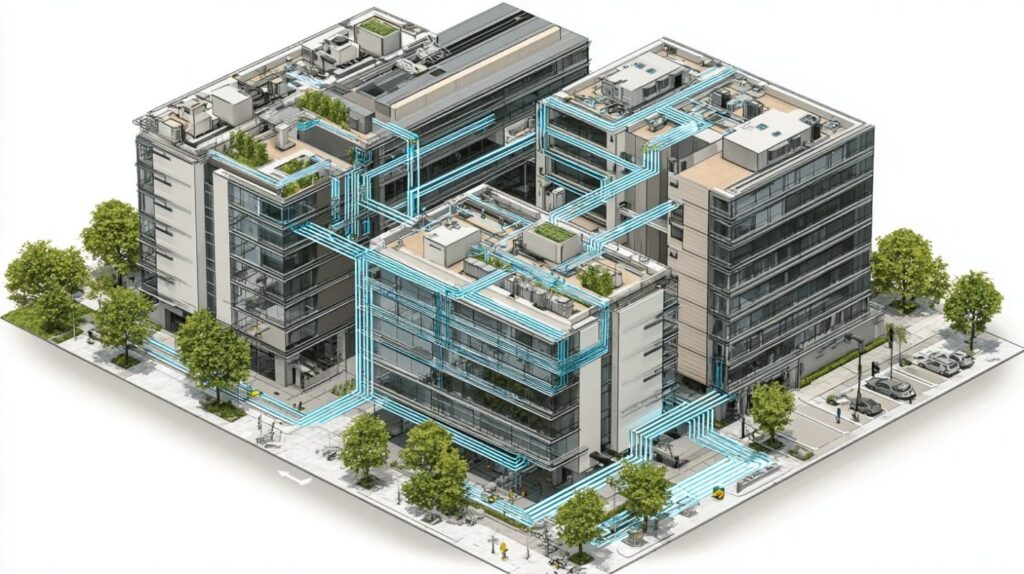
Enter 10BASE-T1L – Ethernet Designed for the Field
This is where things begin to get exciting.
10BASE-T1L is an optimized Ethernet technology specifically designed for industrial and building automation applications. Unlike traditional Ethernet, which requires four wire pairs and is generally limited to 100 meters, 10BASE-T1L operates on a single twisted pair and can support communication distances approaching 1,000 meters.
From an engineering standpoint, this is a significant development.
For the first time, native Ethernet communications can now be deployed over distances traditionally associated with RS-485 while maintaining the benefits of an IP-based network.
In practical terms, this means BACnet/IP can now be extended directly into field-level devices without many of the limitations associated with traditional Ethernet infrastructure.
Why BACnet/IP over 10BASE-T1L Matters
The real value of BACnet/IP over 10BASE-T1L is not simply higher speed. The real value is architectural simplicity.
Historically, building automation systems often required multiple network layers:
- BACnet MS/TP trunks
- Ethernet backbones
- Routers
- Gateways
- Protocol converters
Each additional layer adds cost, complexity, maintenance requirements, and potential points of failure.
BACnet/IP over 10BASE-T1L offers an opportunity to simplify these architectures by extending Ethernet closer to the equipment being controlled.
The results can be:
- Reduced infrastructure requirements
- Fewer protocol conversions
- Simplified commissioning
- Easier troubleshooting
- Improved system visibility
- Better long-term scalability
Perhaps most importantly, technicians can interact with field devices as native IP devices rather than navigating through multiple layers of network translation.
A Practical Migration Strategy
One misconception is that to implement 10BASE-T1L, it requires entirely replacing existing systems, but that is not the approach I recommend.
The reality is that BACnet MS/TP, BACnet/IP, and BACnet/IP over 10BASE-T1L will coexist for many years. Every building has unique requirements, existing infrastructure, and budget constraints.
The most successful projects will likely be hybrid systems that leverage the strengths of each technology.
Existing BACnet MS/TP networks can continue operating effectively, and existing BACnet/IP remains an excellent choice for supervisory systems and enterprise connectivity.
10BASE-T1L can then be strategically introduced to provide long-distance Ethernet connectivity where it delivers the greatest value.
This phased approach allows building owners the ability to modernize their systems without abandoning previous investments.
Looking Ahead
At Smart Controls, we view 10BASE-T1L as one of the most significant advancements in building automation networking in many years.
It combines many of the benefits that engineers appreciate about RS-485 networks (distance, simplicity, and cost-effectiveness) with the performance, flexibility, and connectivity advantages of Ethernet.
As we continue developing our next-generation 10BASE-T1L building automation solutions, our goal is simple: to provide innovative technologies that improve performance, reduce complexity, and help our customers transition confidently into the future.
The building automation industry is evolving rapidly. Data requirements continue to increase. Remote access is becoming essential. Integration between systems is expanding.
The networks that support these systems must evolve as well.
BACnet MS/TP helped build our industry.
BACnet/IP transformed enterprise connectivity.
Now, BACnet/IP over 10BASE-T1L offers an exciting opportunity to combine the best aspects of both technologies into a simpler, more scalable, and more future-ready network architecture.
The future of building automation is not about replacing everything overnight. It is about creating smarter pathways forward. That is exactly what we are working toward at Smart Controls.
To learn more about 10BASE-T1L networking, BACnet integration, and the next generation of building automation controllers, visit Smart Controls and follow our ongoing series of technical articles, videos, and product announcements.