
In the previous article “Understanding BACnet/IP: Why BBMDs Exist and Where 10BASE-T1L Fits”, we introduced how the BBMD plays an important part of BACnet/IP communication and that 10BASE-T1L can allow building automation networks the opportunity to use existing network infrastructure. Now let’s take a closer look at the BBMD’s role in the network.
How Does the BBMD Work?
The easiest way to understand a BBMD is to think of it as a BACnet broadcast forwarding manager.
Consider a simple example BACnet/IP network with two subnets:

When the BACnet Workstation on Subnet A generates a broadcast, BBMD-A recognizes that the BACnet broadcast needs to be shared with other BACnet/IP networks.
Because IP broadcasts generally do not transmit through an IP router, the BBMD provides the capability to forward the BACnet information to the BBMD associated with Subnet B.
BBMD-B receives that information and distributes the BACnet broadcast onto its local subnet.
The controllers on Subnet B can now receive the same BACnet broadcast request.
The process also works in the opposite direction.
This creates a controlled mechanism for BACnet broadcast traffic to travel between networks while still respecting the subnet boundaries established by the IP infrastructure.
The Broadcast Distribution Table
The BBMD uses the Broadcast Distribution Table, commonly called the BDT, to contain the information needed to identify other BBMDs participating in the BACnet/IP broadcast distribution system.
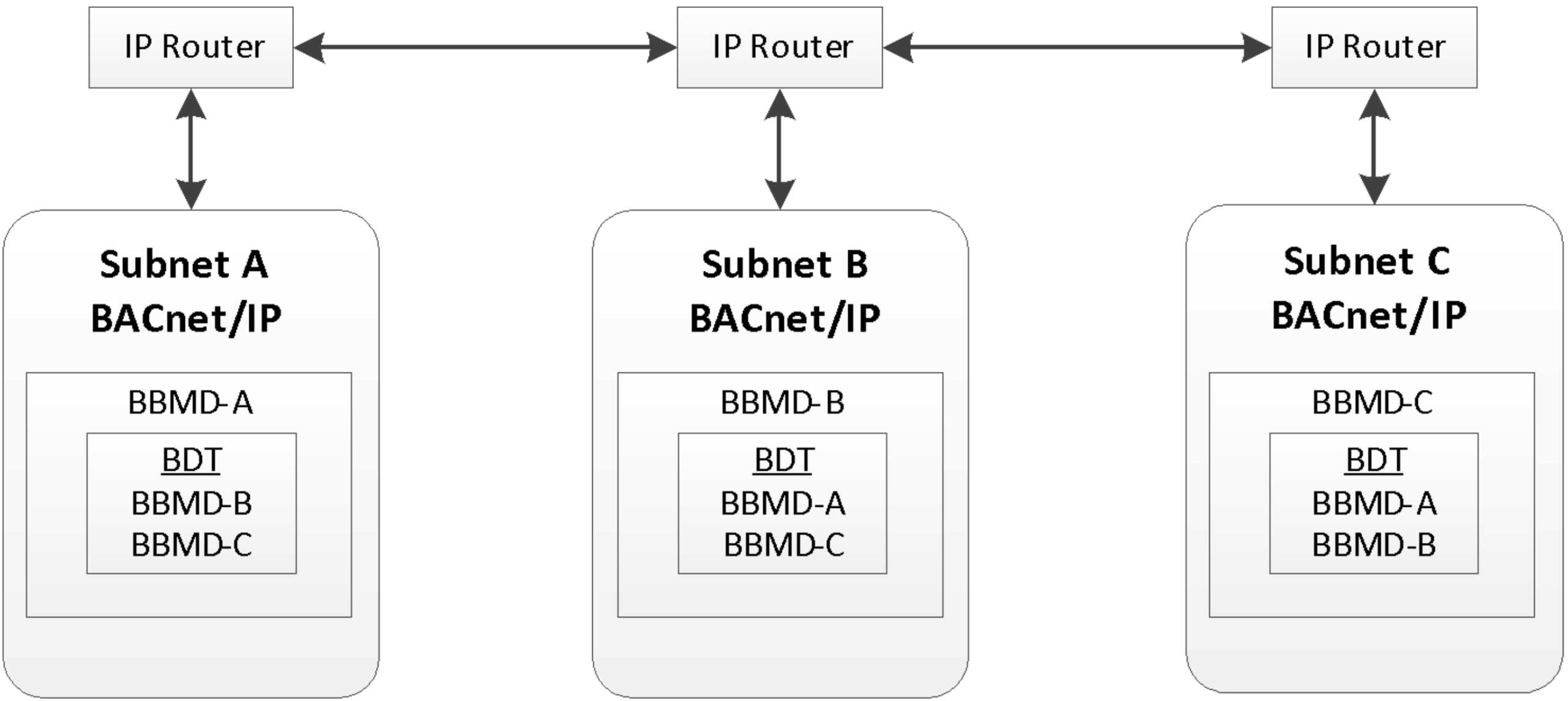
When a BACnet broadcast originates on one subnet, the BBMD uses this configuration to forward the appropriate BACnet message to the other participating BBMDs.
Those BBMDs then make the broadcast available to BACnet devices on their respective local networks.
The BDT therefore establishes the relationship between the BBMDs that cooperate to distribute BACnet broadcast traffic.
How Many BBMDs Are Required?
Only one BBMD is required per subnet. The subnet does not need to have a BBMD on each BACnet device
This is an important distinction because a BBMD is not simply another BACnet device. The BBMD only performs a specific network-management function.
Does the BBMD Reside in the IP Router?
An IP router operates primarily at the IP networking level. It moves IP packets between different IP networks according to routing rules.
A BBMD understands the BACnet/IP broadcast-management mechanism.
Therefore, the BBMD function might reside in a BACnet controller, a BACnet supervisory controller, a BACnet gateway, a BACnet router, or another device specifically designed to provide BBMD functionality.
A device could combine IP routing and BBMD functions into the same physical product.
But the two functions remain conceptually different.
The IP router connects the IP networks.
The BBMD manages BACnet broadcast distribution between those networks.
Understanding this distinction becomes increasingly important as building automation systems move toward standard Ethernet and IP infrastructure.
BBMD is About IP Subnets — Not the Ethernet Cable
This distinction becomes particularly important as the building automation industry begins adopting Single Pair Ethernet and 10BASE-T1L.
A BBMD is fundamentally associated with BACnet/IP and IP subnet boundaries, not with a particular Ethernet physical layer.
As such, BBMDs can be used with 10BASE-T, 100BASE-TX, Gigabit Ethernet, Fiber Ethernet and most importantly with 10BASE-T1L Single Pair Ethernet.
The physical layer determines how the Ethernet information travels across the medium.
IP determines how packets are addressed and routed between networks.
BACnet/IP determines how BACnet messages are transported using IP.
The BBMD determines how BACnet broadcast messages are distributed between BACnet/IP networks separated by IP subnet boundaries.
These are separate layers performing separate jobs.
Where Does 10BASE-T1L Fit?
Traditional Ethernet has historically been concentrated at higher levels of a building automation architecture — workstations, servers, supervisory controllers, and building-level networks.
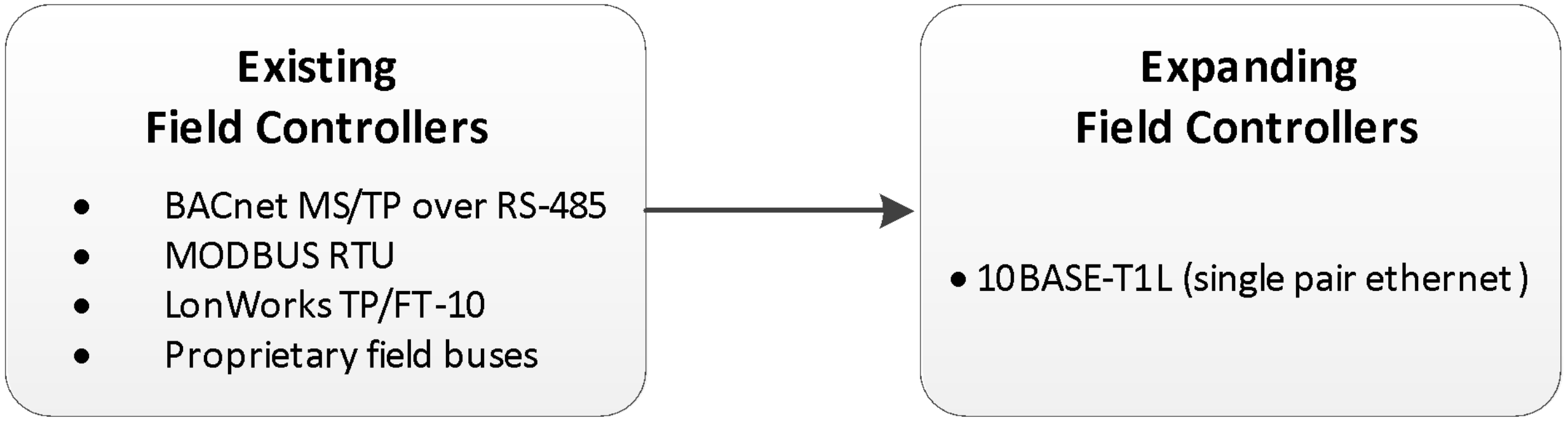
10BASE-T1L creates the opportunity to extend Ethernet much farther toward field-level devices using a single twisted pair and cable distances of up to approximately 1,000 meters under appropriate installation conditions.
Instead of repeatedly converting between Ethernet and different fieldbus technologies, future controllers and sensors can increasingly become native Ethernet/IP devices.
Moving BACnet devices onto 10BASE-T1L does not eliminate IP networking principles.
If the network contains multiple IP subnets, BACnet broadcasts still have to be managed across those subnet boundaries.
Why This Matters For Existing Buildings
Many buildings already contain extensive twisted-pair wiring installed for RS-485 or Free-Topology networks.
Historically, moving those systems to Ethernet would require replacing significant portions of the field wiring.
Single Pair Ethernet can provide an opportunity to reuse portions of that infrastructure (when existing cabling meets the necessary requirements) to move buildings toward significantly higher communication speeds and native Ethernet connectivity.
The result allows for a gradual and economic migration:

As soon as the new IP architecture contains multiple subnets, the system designer must once again consider how BACnet broadcasts will move between them.
That brings us directly back to the BBMD.
BBMDs Help BACnet Scale
Subnet boundaries are useful to improve network management, cybersecurity, and scalability.
BACnet provides mechanisms for operating within this structured IP environment using subnets.
The BBMD allows BACnet broadcast-based services to function across routed IP networks without requiring the underlying IP infrastructure to operate as one subnet in a domain.
The Key Point
A BBMD allows BACnet broadcast information to cross IP subnet boundaries.
The BBMD works with BACnet/IP to ensure that important BACnet broadcast services can operate across a network containing multiple IP subnets.
Whether those Ethernet connections use conventional four-pair Ethernet or modern Single Pair Ethernet, the principle remains essentially the same.
As building automation moves toward increasingly IP-based architectures, understanding BBMDs becomes an important part of understanding how BACnet scales from a small network to an entire building, campus, or enterprise.
Next: What Happens When BACnet Broadcasts Cross Multiple Subnets?
In the next article, “BACnet Broadcasts: Who-Is, I-Am, and Device Discovery over 10BASE-T1L”, we will explain broadcast types, such as Who-Is, I-Am, Who-Has, and I-Have and show that BACnet/IP discovery works at higher network layers while 10BASE-T1L operates underneath as the Ethernet physical layer.
This analysis will help give a clearer picture of how BACnet discovery actually works across a modern routed Ethernet network — including networks that increasingly extend Ethernet to the field level through 10BASE-T1L Single Pair Ethernet.