
Making 10BASE-T1L Practical: The Role of Media Converters in Modern Building Networks
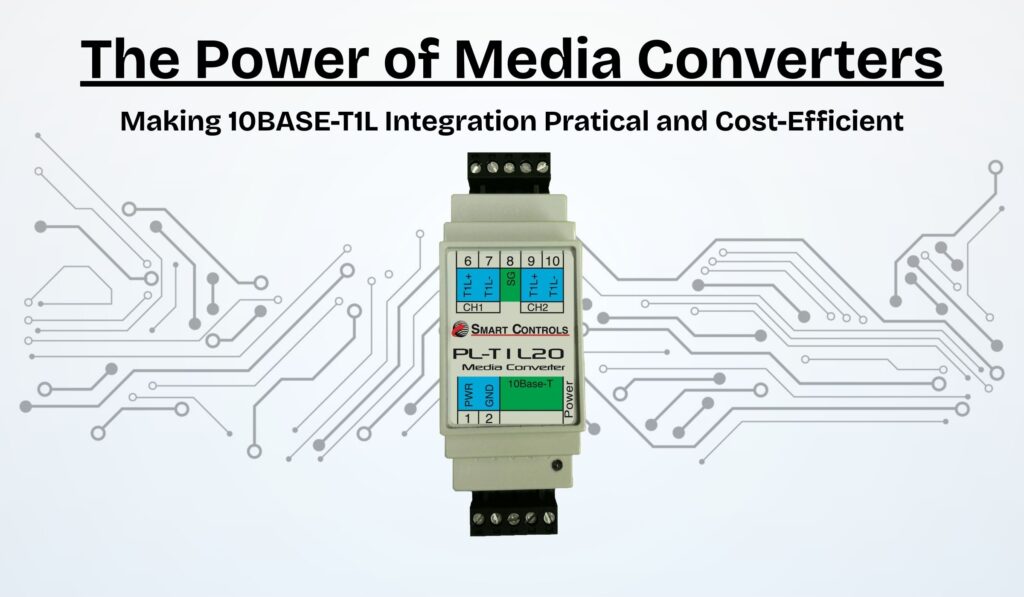
As building networks evolve from isolated control systems to unified, IP-centric architectures, a new bridge is becoming critical in the system design toolkit: the 10/100BASE-T to 10BASE-T1L media converter.
This small device plays a critical role in enabling the long-reach, low-cost, IP-based topologies that modern HVAC, lighting, energy, and access control systems demand. Without it, the advantages of 10BASE-T1L simply cannot be brought into an existing Ethernet network.
In many ways, media converters are the missing link between where buildings are today and where connected building design is heading next.
The Challenge: Introducing Single Pair Ethernet into Existing Networks
Most commercial buildings already have a well-established Ethernet backbone built on standard 10/100BASE-T Ethernet switches, routers, and firewalls. These IT networks are reliable, familiar, and deeply integrated into enterprise operations.
10BASE-T1L, on the other hand, is purpose-built for the future of the building:
- Long cable runs up to 1000 meters (~3280 feet)
- Single twisted pair wiring
- Low power consumption
- Optimized communication for sensors, controllers, and field devices
The challenge is obvious: traditional Ethernet and 10BASE-T1L don’t physically connect to each other. 10BASE-T uses four twisted pairs and RJ-45 connectors, while 10BASE-T1L uses a single pair and specialized PHYs.
That’s where media converters come in.
What Is a 10/100BASE-T to 10BASE-T1L Media Converter?
At its core, a media converter is a simple but powerful device that:
- Accepts standard Ethernet (10/100BASE-T) on one side
- Converts the signal to 10BASE-T1L on the other
- Maintains Ethernet framing, IP traffic, and network transparency
From your network’s point of view, it’s still Ethernet, but from the field device’s point of view, it’s communicating over long-reach Single Pair Ethernet.
No protocol translation. No gateways. No custom drivers.
Just Ethernet — extended.
Why Media Converters Matter for Building Automation
1. Seamless Integration with Existing IT Infrastructure
Media converters allow 10BASE-T1L devices to connect directly into:
- Existing Ethernet switches
- Standard VLANs and IP subnets
- Current cybersecurity and network monitoring tools
This means building automation systems don’t need a parallel network or special IT accommodations. Control systems can live comfortably alongside other IP-based building services.
2. Extending Ethernet to the True Edge of the Building
With a media converter acting as the transition point, Ethernet can now travel:
- From a network closet
- Through a single twisted pair
- Up to 1000 meters (~3280 feet) away
- Directly to remote controllers, sensors, or I/O
Mechanical rooms, rooftops, parking structures, risers, and long corridors are no longer “hard-to-reach” network zones. Media converters effectively turn standard Ethernet into a long-reach building network without adding intermediate switches.
3. Simplifying Retrofit and Brownfield Projects
Many existing buildings already contain miles of spare or underutilized control wiring. Media converters make it possible to:
- Reuse existing 18–22 AWG twisted pair cabling
- Avoid costly new Cat 5e/6 cable pulls
- Reduce conduit, labor, and installation time
For retrofit projects, this can be the difference between a feasible upgrade and a prohibitively expensive one.
4. Enabling New Network Topologies
By placing media converters strategically, designers gain flexibility in how systems are laid out:
- Point-to-Point: Ethernet switch → media converter → remote controller
- Distributed Zones: One switch feeding multiple long-reach T1L runs
- Panel-Level Integration: Converting Ethernet to T1L inside control panels to reach downstream devices
Instead of forcing building layouts to conform to network limits, the network can finally follow the building.
Media Converters as a Design Tool — Not a Band-Aid
It’s tempting to think of media converters as a temporary workaround, but in reality, they are a deliberate design component in modern building automation architectures.
They allow system designers to:
- Gradually introduce 10BASE-T1L without ripping out existing networks
- Mix traditional Ethernet devices and next-generation field devices on the same IP backbone
- Scale systems incrementally as new T1L-enabled products are deployed
In short, media converters make 10BASE-T1L usable today — not just in future greenfield projects.
Designing with Media Converters in Mind
When planning your next building automation system:
- Identify where standard Ethernet ends and long-reach connectivity begins
- Use media converters as the transition point between IT infrastructure and field-level devices
- Place converters where they simplify wiring, reduce switches, and extend reach
- Think of Single Pair Ethernet as an extension of Ethernet — not a replacement
Conclusion
10BASE-T1L unlocks new possibilities for how building automation systems are designed, deployed, and scaled. But it’s the 10/100BASE-T to 10BASE-T1L media converter that makes those possibilities practical in the real world.
By bridging traditional Ethernet networks with long-reach Single Pair Ethernet, media converters enable seamless integration, simpler retrofits, and smarter network topologies — all while keeping everything on a unified IP foundation.
At Smart Controls, we see media converters as a key enabler in the transition to next-generation building automation. As we incorporate 10BASE-T1L into our future product lineup, these devices will play an essential role in helping our customers modernize their systems without unnecessary complexity.
Curious how media converters and 10BASE-T1L can enhance your next project? Connect with Smart Controls to start the conversation today.